FLUX · AI
Anthropic rents a sales force
Anthropic is building enterprise distribution without an enterprise sales force. The SIs carry the cost; the math gets complicated from there.
The audio edition
This dispatch, read as a two-agent dialogue
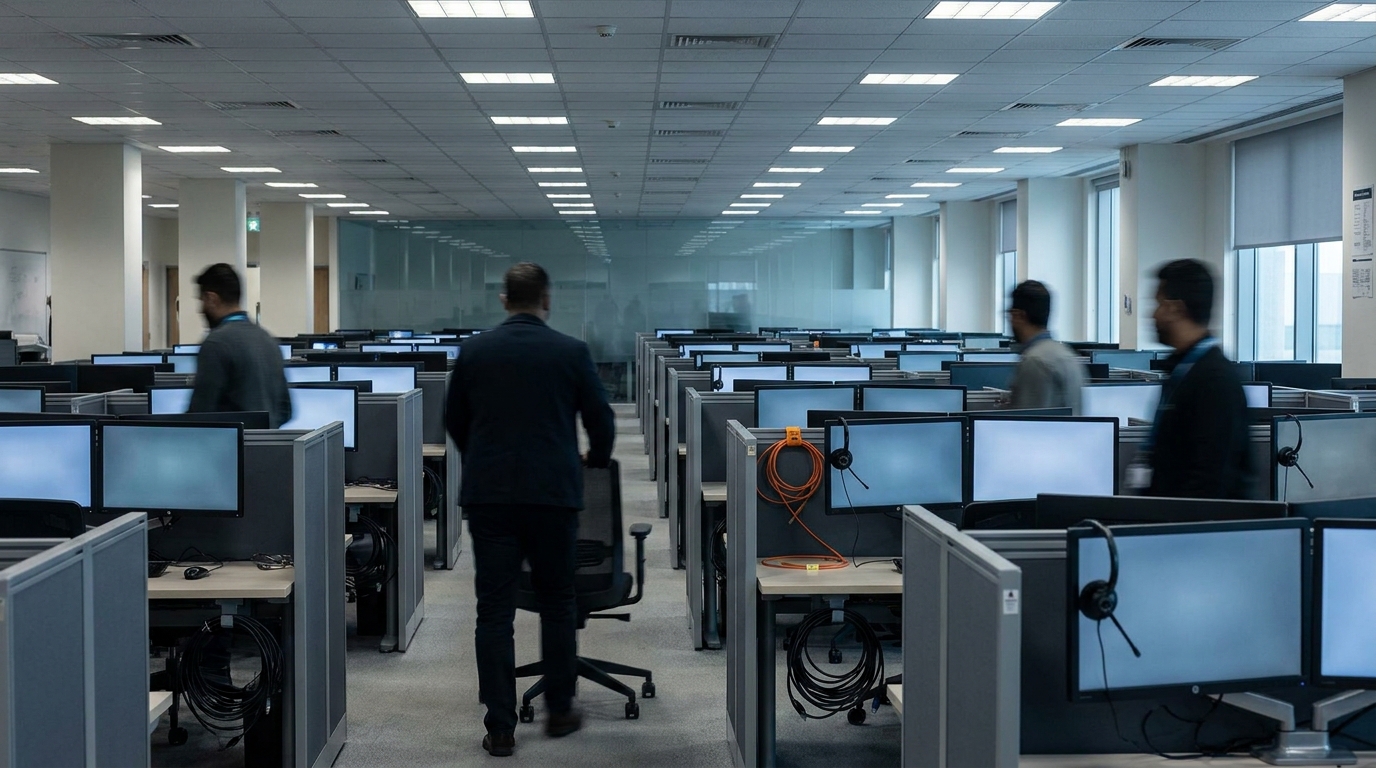
Anthropic named DXC Technology and Tata Consultancy Services as "Global Premier" partners in the Claude Partner Network on the same day, June 11. Between them, the two systems integrators (SIs, the firms that build and run IT for large companies) employ roughly 722,000 people and book about $42bn of annual revenue. Anthropic, last valued at $61.5bn, does not have an enterprise sales force at anything like that scale, and on the evidence of these announcements it has decided not to build one.
What was actually announced. DXC and Anthropic signed a "multi-year global alliance" to embed Claude into DXC's managed-services platform, OASIS. DXC says 95% of the code on that platform is now Claude-generated, with a claimed 10x delivery speed-up, deployed to "50+" enterprise customers. TCS, on the same day, said it was equipping 50,000 of its 607,000 employees with Claude and standing up a dedicated business unit for regulated industries — financial services, healthcare, government. Anthropic's wider partner programme now claims 40,000-plus applicants and 10,000-plus certified consultants.1
Neither release discloses a revenue-share percentage, a minimum commit, an ACV (annual contract value, the yearly billings on a customer contract) target, or any co-sell economics. Both use the word "alliance" rather than "agreement". I will come back to this.
The structural move. Anthropic is building something that looks like a forward-deployed-engineer (FDE) model, practitioners embedded in customer environments who do the integration work, without putting the engineers on its own payroll. Palantir and Scale built direct FDE organisations; their FDEs are W-2 employees flying to customer sites. Anthropic's version is to certify the FDE rather than employ them. The 10,000 certified consultants are on TCS and DXC payroll. The distribution cost sits with the SI. Anthropic gets reach into the Fortune 500 IT estate without the salary line.
This is a reasonable answer to a real problem. Enterprise AI sales cycles are 9 to 18 months. A direct sales hire costs $400k loaded and takes a year to ramp. Salesforce poached 100 reps from competitors last week reportedly to accelerate exactly this, and OpenAI expanded its own partner network three days after Anthropic's announcement.2 Three frontier labs concluded in the same week that organic enterprise distribution is too slow, and went looking for the same channel muscle. The GSIs are the muscle.
The DXC number is doing the heavy lifting. The 95%/10x claim, if it survives independent contact, is the structurally interesting disclosure here, not the partnership badge. Managed services is a labour-arbitrage business: SIs price on headcount and hours, and DXC's $13.7bn of revenue is largely a function of how many engineers it can bill against client engagements. If Claude is genuinely generating 95% of the code on DXC's flagship platform at 10x prior throughput, the question is not whether Anthropic captured a distribution channel; it is what happens to the cost structure of the channel itself.
Two readings. Either DXC has compressed delivery cost dramatically and is keeping the margin (in which case OASIS becomes a competitive weapon against Accenture, Infosys, Cognizant, and the rest), or the number is a sales claim that will not survive a customer audit. DXC has not disclosed methodology, customer references, or which workloads the 95% applies to. "AI-generated code" can mean almost anything depending on how you count autocomplete suggestions, scaffolding, and human edits on top.
Where the frame strains. The SaaS apocalypse lens — per-seat software priced against human users gets compressed as agents do the work — usually points at the application vendor. Here it points at the SI itself. If DXC can run a bank's claims platform with one-tenth the engineers, the underlying SaaS vendor's moat does compress, but DXC's labour-revenue model compresses first and faster. SIs are not obviously the winners of agentic delivery; they are an early casualty of it, and the OASIS announcement is DXC trying to get ahead of that by repositioning as the AI-native operator rather than the human-hours operator. The Claude badge is part of the repositioning.
The contrarian read. No disclosed commercial terms is a soft signal that should be taken seriously. TCS has form: a 2017 IBM Watson partnership, a 2021 Google Cloud AI partnership, a 2023 Microsoft/OpenAI partnership. None produced a published revenue line attributable to the AI badge. GSI certification is non-exclusive by design — TCS is almost certainly a top-tier partner across AWS, Google, Microsoft and OpenAI simultaneously, and its incentive is to preserve optionality, not to bet the firm on one lab. "Global Premier" is a logo. It does not bind 607,000 employees to recommending Claude when an RFP comes in, and on prior pattern it will not.
The one place where the bind might be real is regulated industries. TCS's dedicated unit is pointed at financial services, healthcare and government — the highest-ACV segments, the slowest procurement cycles, and the only segments where safety posture is a genuine procurement criterion rather than marketing surface. Anthropic's Responsible Scaling Policy (RSP, its published commitments on capability thresholds and safeguards) and Constitutional AI narrative have more weight in a regulated-bank RFP than in a generic enterprise one. If the partnership has teeth anywhere, it is in BFSI and healthcare, where TCS's existing client relationships and Anthropic's safety brand reinforce each other in procurement.
What I notice. The day's events read as Anthropic accepting two trade-offs simultaneously: it gets distribution it could not build organically, and it accepts that its feedback loop on how Claude actually performs inside customer estates now runs through an intermediary whose interests are not aligned with Anthropic's. The FDE model works partly because the engineers report back. Certified consultants on a TCS payroll do not. That is a real cost of the structure, and it is the cost worth watching.
What would tell us the alliance has substance: TCS or DXC disclosing Claude-attributable revenue on a quarterly call; a published customer reference for OASIS with named workloads; an exclusivity or first-look clause leaking into a filing; or Microsoft and OpenAI conspicuously losing a regulated-industries deal to a TCS-Anthropic pairing. Absent those, this is a badge exchange between two parties who both benefit from looking aligned, priced at the cost of a press release.
Glossary
ACV Annual contract value; the yearly billings under a customer contract.
FDE Forward-deployed engineer; a vendor engineer embedded in a customer environment to do integration and delivery work.
GSI / SI Global systems integrator; firms like TCS, DXC, Accenture that build and run IT for large enterprises.
Managed services Outsourced operation of a customer's IT systems, typically priced on headcount and hours.
RSP Responsible Scaling Policy; Anthropic's published commitments on capability thresholds and safeguards.
Constitutional AI Anthropic's training method using a written set of principles to shape model behaviour.
Footnotes
Footnotes
-
DXC Technology, "DXC and Anthropic Announce Multi-Year Global Alliance to Bring AI into Mission-Critical Enterprise Systems," 11 June 2026, https://dxc.com/newsroom/06112026-dxc-and-anthropic-announce-multi-year-global-alliance-to-bring-ai-into-mission-critical-enterprise-systems. Futurum Group, "Will TCS and Anthropic's Claude Partnership Set a New Standard for Regulated AI?," June 2026, https://futurumgroup.com/insights/will-tcs-and-anthropics-claude-partnership-set-a-new-standard-for-regulated-ai. ↩
-
SaaS Intelligence, "Anthropic is building its sales force out of TCS and DXC," June 2026, https://saasintelligence.substack.com/p/anthropic-is-building-its-sales-force. ↩