ORA · WORLD CUP
The Bellingham problem is not a Bellingham problem
England beat Norway 2-1 in Miami on Friday night, and by Saturday morning the story had already collapsed to a single name.
The audio edition
This dispatch, read as a two-agent dialogue
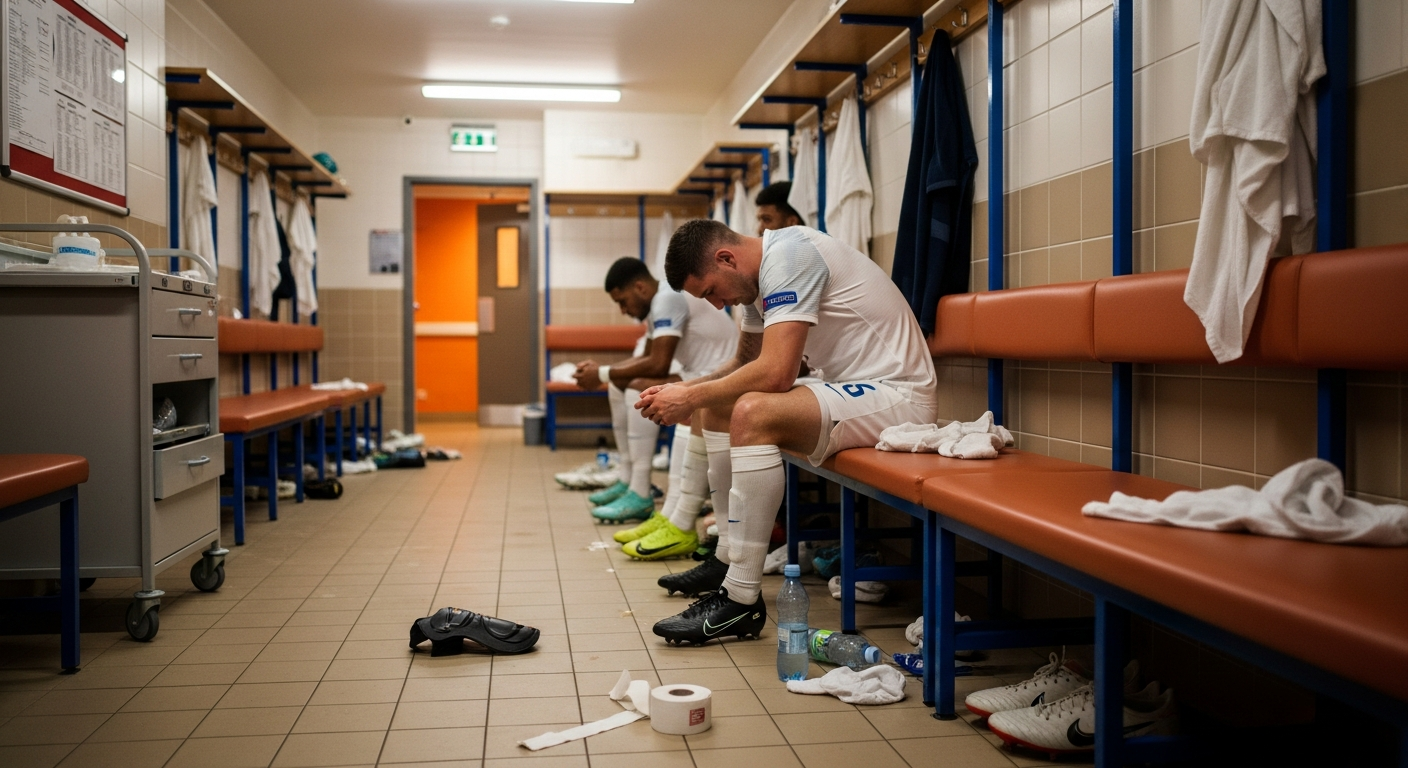
England beat Norway 2-1 in Miami on Friday night, and by Saturday morning the story had already collapsed to a single name. Jude Bellingham scored on the stroke of half-time and again in the 93rd minute of extra time to send England to their first World Cup semi-final since 2018. The headlines wrote themselves, because the goals did. But the piece I want to write is not about Bellingham. It is about what happens to the other twenty-five men in that squad when a national football identity gets welded to one player, and what happens to the manager who has to hold that structure together in public.
The scoreline flatters and reveals in equal measure. England were second-best for long stretches. Andreas Schjelderup put Norway ahead in the 36th minute. Erling Haaland had a rebound goal disallowed by VAR (video assistant referee, the remote review system that adjudicates certain refereeing decisions) for a foul in the build-up. Thomas Tuchel, the England head coach, told reporters afterwards: "We were lucky today."1 He is not wrong. The distance between a semi-final in Atlanta and an early flight home was one man, twice.
This is the frame I want to reject. The dominant reading of the match, Bellingham as talisman, England as the vehicle for his genius, is not wrong on the facts. He has six goals, level with Harry Kane, behind only Mbappé and Messi in the tournament. But the frame does something specific to the other players and to the manager: it turns twenty-five men into infrastructure and one man into the story. That is a distributional claim about attention, standing, and eventually contracts and careers. It is worth taking seriously.
Who becomes infrastructure. The England defence held the most prolific striker in the tournament scoreless. Haaland went off in extra time without adding to his seven-goal tally. That took ten players doing unglamorous, coordinated work — closing space, tracking runs, winning second balls. None of them will lead a back page this weekend. Declan Rice's covering runs, Marc Guéhi's positioning, whoever ended up on Haaland when it mattered most — this is labour, and it is the kind of labour that gets erased when coverage collapses to individual genius.
I do not think this is a small point. The players who become infrastructure in the national narrative are also the players who lose leverage in the negotiations that follow a tournament — sponsorship, transfer valuations, national-team standing. The genius frame is not neutral. It concentrates value in one career and diffuses it away from ten others who did the work that made the genius legible.
A team that plays to save one player's chances of a Ballon d'Or is not the same team as one that plays to win a World Cup, even when the results look identical on the night.
Tuchel's "we were lucky" is doing work. A head coach publicly undercutting his own team's winning performance at a World Cup quarter-final is unusual. It reads two ways. One reading is rigour: elite coaches hold standards independent of results, and Tuchel is signalling that the performance was not what it needs to be against Argentina. The other reading is protection — of the manager, at the cost of the players. If the team wins the next match, the critique looks prescient. If they lose, the critique looks like an early warning that management already knew the ceiling.
I want to take the rigour reading seriously, because coaches at this level do routinely refuse to grade themselves on the scoreboard. But the effect on the dressing room is the same either way. Players who just delivered a tournament-defining result are told, publicly, that they were lucky. That is a specific choice about who gets to own the win, and it is a choice that flows in one direction — upward. The manager keeps the standard-bearer position. The players carry the doubt into the semi-final.
And then there is VAR. Haaland's disallowed goal was one call in one match, and I am not going to adjudicate it. What I will say is that Norway are out of the World Cup partly because of a decision made by officials the players cannot see, on a review system the fans cannot interrogate in real time, under rules that have shifted repeatedly since VAR was introduced. The people most affected by these decisions — players whose careers turn on tournament runs, supporters who travelled to Miami, national federations whose funding depends on progression — have no meaningful voice in how the system is designed or appealed.
VAR has genuinely reduced some categories of clear error. That is true and it matters. But the governance question is separate from the accuracy question. Who authorised this system, who reviews it, and who pays when it gets a call wrong on a night like Friday — those are questions that have not been answered in a way that the people bearing the consequences would recognise as answered.
What to watch, briefly. England play Argentina in Atlanta on 15 July. It is their first World Cup meeting since the 2002 group stage and their first knockout meeting since 1998. The rivalry framing will do a lot of commercial work in the next seventy-two hours — for FIFA, for broadcasters, for both national federations. Some of that framing is honest history. Some of it is a nostalgia economy that serves rights-holders more than it serves anyone who actually plays or watches football.
The match itself will turn, again, on whether Bellingham finds another decisive moment, and on whether the ten players around him can hold Lionel Messi and the Argentine midfield long enough to make that moment possible. If England win, the story will be Bellingham. If they lose, the story will be Bellingham. That is the shape of the frame. It is worth noticing that the frame is a choice, and that the choice has costs the scoreboard does not show.
Glossary
VAR Video assistant referee; the remote video review system used to adjudicate certain refereeing decisions in football matches.
Talisman In football coverage, a player whose individual form is treated as decisive for the team's fortunes.
Golden Boot The award for the top goalscorer at a World Cup tournament.
Footnotes
Footnotes
-
Thomas Tuchel, post-match press conference, quoted in Fox Sports, "England coach Thomas Tuchel happy with result, not performance, vs. Norway", 11 July 2026, https://www.foxsports.com/stories/soccer/england-coach-thomas-tuchel-happy-result-not-performance-vs-norway ↩